Work From Anywhere — and Actually Mean It: How Remote Workers Are Rewriting the Rules of Exploration
For most of American history, travel was something you squeezed into two weeks of PTO and a carefully budgeted savings account. You picked a destination, booked a resort, ate at the places in the guidebook, and flew home Sunday night so you could be at your desk by Monday morning. That was the deal.
Then the deal changed.
The pandemic didn't just shuffle office workers into their spare bedrooms — it fundamentally broke the assumption that your job required you to be in any particular place. And once that assumption cracked, a lot of people started asking a question they'd never seriously entertained before: If I can work from home, why can't home be somewhere else entirely?
Millions of Americans have answered that question by buying a one-way ticket and figuring out the rest on the ground.
Not a Vacation. Not an Expat Life. Something New.
Here's what makes this wave of travelers different from anything that came before it. They're not tourists — they're not rushing from landmark to landmark with a selfie stick and a three-night hotel booking. But they're not traditional expats either. They're not relocating for a job transfer or retiring abroad. They're something genuinely new: people who are living somewhere temporarily, on their own terms, while still earning an American income.
That combination creates a completely different relationship with a place.
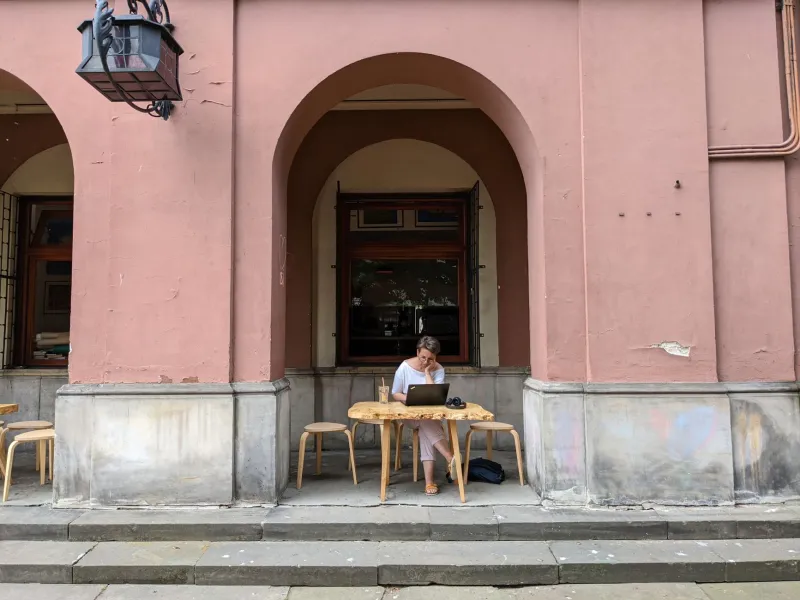
When you're staying somewhere for six weeks instead of six days, you stop looking for the highlights. You find a coffee shop you like and you go back. You learn which market has the best produce and which one is a tourist trap. You get to know your neighbors — not as colorful local characters in your travel story, but as actual people whose lives intersect with yours in small, unremarkable, meaningful ways.
That's the part the Instagram grid doesn't capture. The mundane magic of just being somewhere long enough for it to feel a little bit like yours.
Why They're Skipping Paris
Here's something interesting: ask a remote worker where they've been living lately, and the answer is rarely the place you'd expect. Paris, Rome, Tokyo — the classic bucket-list cities — come up less often than Medellín, Tbilisi, Chiang Mai, or the Alentejo region of Portugal.
There are practical reasons for this. Cost of living matters when you're not on a vacation budget but a monthly budget. A comfortable apartment in Lisbon's trendy Bairro Alto neighborhood costs a fraction of what the equivalent would run in New York. A coworking space in Oaxaca, Mexico, might cost less per month than a single tank of gas back home.
But it's not just economics. There's a certain kind of traveler who actively avoids the places that have already been thoroughly discovered and thoroughly optimized for tourists. They're looking for cities with real texture — places where the infrastructure for visitors exists but hasn't yet steamrolled whatever made the place interesting in the first place.
That search is sending Americans to corners of the world that rarely showed up in travel writing a decade ago. And those places are noticing.
The Communities on the Other Side of the Equation
It would be easy to write this story entirely from the traveler's perspective — the freedom, the adventure, the personal growth. But there's another side to it that deserves equal space.
The communities absorbing this wave of mobile workers are experiencing something complicated. In some places, the influx of higher-earning foreigners has been genuinely good for local economies. Restaurants stay open longer. Small guesthouses thrive. English-language skills become more valuable. Locals who offer guided tours, language lessons, or freelance services find a ready market.
But in other places — and this is worth being honest about — the math gets harder. When a neighborhood becomes popular with remote workers, rents tend to follow. Long-term residents who've lived somewhere for generations can find themselves priced out of their own neighborhoods. It's a version of gentrification that plays out on a global scale, and the Americans arriving with their laptops and their Venmo accounts aren't always aware of the role they're playing in it.
The most thoughtful remote workers are grappling with this openly. They're asking how to be present in a place without distorting it. They're choosing locally owned accommodations over international chains, eating at spots that serve the neighborhood rather than the visitors, learning at least functional phrases in the local language. It's not a perfect solution, but it's a more conscious approach to travel than the old model ever really encouraged.
What You Actually Learn Out There
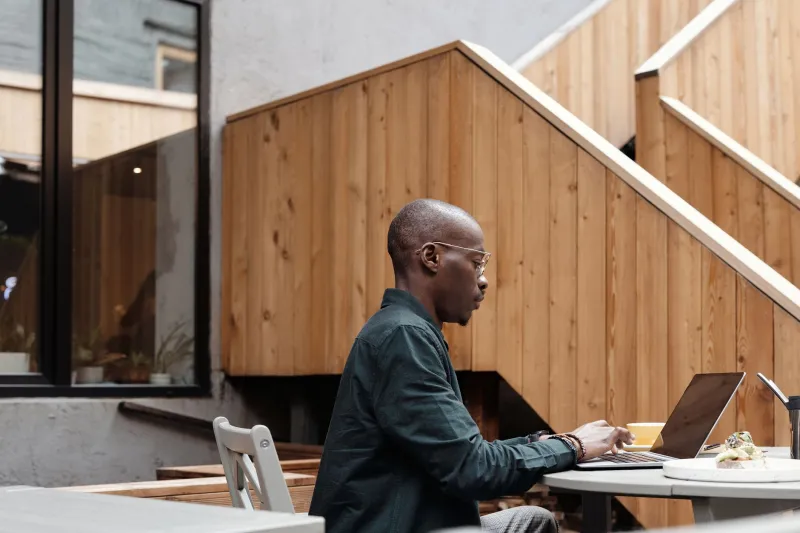
Spend enough time working from a café in a city where you don't speak the language fluently, and something shifts. You get comfortable with not understanding everything. You get better at reading situations instead of relying on words. You develop a tolerance for ambiguity that is — and this is not an overstatement — genuinely hard to build any other way.
Remote workers who've spent significant time abroad tend to describe a recalibration of what they thought they knew about the world. American assumptions about how healthcare should work, what a reasonable commute looks like, how much space a person actually needs to be comfortable — all of these get quietly interrogated when you're living inside a different system for months at a time.
None of that means everywhere else is better. It just means different, and different is instructive in ways that a two-week trip rarely has time to be.
So Where Does This Go?
The remote work revolution isn't going back in the bottle. Companies that tried to drag employees back to five-day office weeks have largely discovered that the leverage has shifted. Talented people have options now, and some of those options include living in Lisbon for a winter or spending a season in Mexico City just because they can.
What that means for travel — and for the destinations on the receiving end — is still being written. New visa categories are emerging specifically for this population. Countries from Barbados to Croatia have created digital nomad visas designed to attract longer-stay visitors who contribute economically without permanently displacing locals.
The experiment is ongoing, and the results are genuinely mixed. But one thing is clear: the old story about what travel is for — leisure, escape, two weeks of not being yourself — has been permanently complicated by the emergence of people who've decided that being themselves is something they can do anywhere on earth.
That's a different kind of traveler. And the world is slowly, unevenly, fascinatingly figuring out what to do with them.